Nature has produced some abilities that sound more like science fiction than biology.
Some animals can survive being frozen. Others can regrow parts of their bodies, see colors humans cannot imagine, or sense electrical signals produced by other living creatures.
These aren’t superheroes from a movie. They’re real animals using extraordinary adaptations to survive every day.
Here are 12 animals with abilities that are difficult to believe until you discover the science behind them.
1. Axolotl — The Master of Regeneration
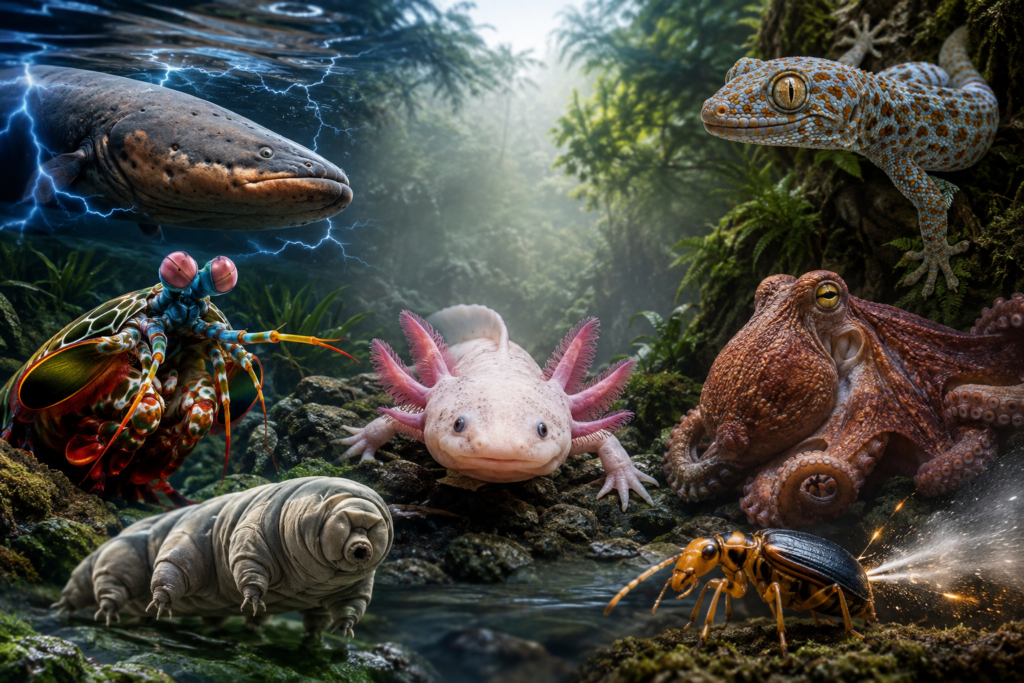
The axolotl may look like a permanently smiling little salamander, but its most impressive feature is hidden beneath the surface.
Axolotls have remarkable regenerative abilities. They can regrow lost limbs and repair several types of damaged tissue without the heavy scarring humans typically experience.
Scientists study axolotls because understanding how they regenerate tissue could provide clues about healing and regeneration in other animals.
Even more unusual, axolotls normally remain aquatic throughout their lives while retaining several juvenile characteristics, including their distinctive feathery external gills.
2. Mantis Shrimp — An Extraordinary Visual System
The colorful mantis shrimp possesses one of the most unusual visual systems in the animal kingdom.
Humans typically have three types of color-sensitive cone cells. Some mantis shrimp species possess far more types of photoreceptors and can detect ultraviolet light and polarized light.
But their eyes aren’t their only impressive feature.
Certain mantis shrimp can strike prey with specialized appendages at extraordinary speeds. The rapid movement can create cavitation bubbles in the water, adding another force to an already powerful blow.
For such a small animal, the mantis shrimp packs an astonishing punch.
3. Electric Eel — A Living Power Generator
Despite its name, the electric eel isn’t actually a true eel. It’s a type of knifefish found in South America.
Its remarkable ability comes from specialized electrical organs containing thousands of electrocytes.
Working together, these cells allow electric eels to generate electrical discharges.
They can use weaker electrical signals for navigation and communication, while stronger discharges can help stun prey and defend against threats.
Essentially, evolution has given this fish its own biological electrical system.
4. Tardigrade — One of Nature’s Ultimate Survivors
Tardigrades are microscopic animals sometimes called water bears because of their chunky bodies and lumbering movements.
Under harsh environmental conditions, some tardigrades can enter an extremely reduced metabolic state known as cryptobiosis.
In this state, certain species can withstand conditions that would quickly kill most animals, including severe dehydration and extreme temperatures.
Researchers have even exposed tardigrades to the vacuum of space during scientific experiments, with some surviving the exposure.
Their incredible durability has made these tiny creatures famous around the world.
5. Gecko — Walking Up Walls
Anyone who has watched a gecko run across a wall or ceiling has seen an extraordinary piece of natural engineering.
Gecko toes are covered with microscopic hair-like structures called setae. These structures branch into even smaller tips that allow extremely close contact with surfaces.
At that scale, weak intermolecular attractions become strong enough collectively to help support the gecko.
The result is an animal capable of racing across surfaces that would be impossible for most creatures to climb.
Scientists have studied gecko feet while developing new adhesive technologies.
6. Octopus — A Master of Disguise
Octopuses are famous for intelligence, but their camouflage abilities are equally impressive.
Specialized structures in their skin allow many octopuses to rapidly alter their appearance. They can change color and patterns, and some can also alter the apparent texture of their skin.
This helps them blend into rocks, coral, sand, and other surroundings.
An octopus can look conspicuous one moment and become remarkably difficult to spot moments later.
Camouflage helps octopuses avoid predators and can also help them approach prey.
7. Bombardier Beetle — Chemical Defense on Demand
When threatened, bombardier beetles have an unusual defensive weapon.
They store chemical ingredients separately inside their bodies. When needed, the chemicals are combined in a specialized reaction chamber.
The resulting reaction allows the beetle to eject a hot, irritating chemical spray toward an attacker.
The system is remarkably controlled and provides a powerful defense for such a small insect.
8. Wood Frog — Surviving Partial Freezing
Winter presents an enormous challenge for small animals living in cold climates.
The wood frog has evolved an extraordinary solution.
During winter, portions of the frog’s body fluids can freeze while the animal enters a remarkable state of suspended activity.
Protective compounds such as glucose help limit damage to cells.
When temperatures rise, the frog thaws and becomes active again.
It’s one of the animal kingdom’s most remarkable cold-weather survival strategies.
9. Platypus — Hunting With Electricity
The platypus is strange even before you examine its senses.
This egg-laying mammal has a duck-like bill, webbed feet and a broad tail.
But its bill contains specialized receptors capable of detecting weak electrical signals produced by muscle activity in prey.
When a platypus dives underwater, it can close its eyes, ears and nostrils and rely heavily on information gathered through its sensitive bill.
Tiny electrical signals can help lead it toward hidden prey.
10. Peregrine Falcon — The High-Speed Hunter
Few animals demonstrate speed as dramatically as the peregrine falcon.
When hunting, a peregrine can climb high above its prey before entering a steep dive called a stoop.
During these dives, peregrine falcons can exceed 200 miles per hour, making them widely recognized as the fastest animals on Earth when diving.
Their streamlined bodies, powerful muscles and specialized respiratory adaptations help them function at tremendous speeds.
11. Archerfish — The Underwater Sharpshooter
Archerfish have developed one of the animal kingdom’s most entertaining hunting techniques.
Instead of waiting for insects to fall into the water, they can shoot carefully aimed jets of water from their mouths.
The stream strikes insects sitting on leaves or branches above the water, knocking them down where the fish can quickly grab them.
Archerfish can compensate for the visual distortion created when looking from water into air, making their accuracy even more impressive.
12. Lyrebird — Nature’s Master Mimic
The superb lyrebird of Australia is famous for its astonishing ability to imitate sounds.
Males incorporate numerous sounds into elaborate vocal displays, including the calls of other bird species.
Lyrebirds have also been documented imitating some sounds they encounter in their environments.
Their vocal abilities demonstrate just how sophisticated communication and sound production can become through evolution.
Why Do Animals Develop Such Incredible Abilities?
These abilities didn’t appear because animals needed “superpowers.”
They developed through evolution.
Traits that helped animals find food, avoid predators, survive difficult environments, attract mates or successfully reproduce could be passed to future generations.
Over enormous periods of time, natural selection produced adaptations that can seem almost impossible from a human perspective.
The mantis shrimp’s unusual vision, the gecko’s remarkable feet and the axolotl’s regenerative abilities are all different solutions to the same basic challenge:
Survive long enough to reproduce.
Nature Is Stranger Than Fiction
Humans often imagine superheroes capable of regeneration, camouflage, incredible speed and extraordinary senses.
Nature developed versions of many of those abilities long before humans began writing superhero stories.
And scientists are still discovering new species and learning surprising things about animals we thought we already understood.
The animal kingdom remains one of the greatest sources of extraordinary stories on Earth.