
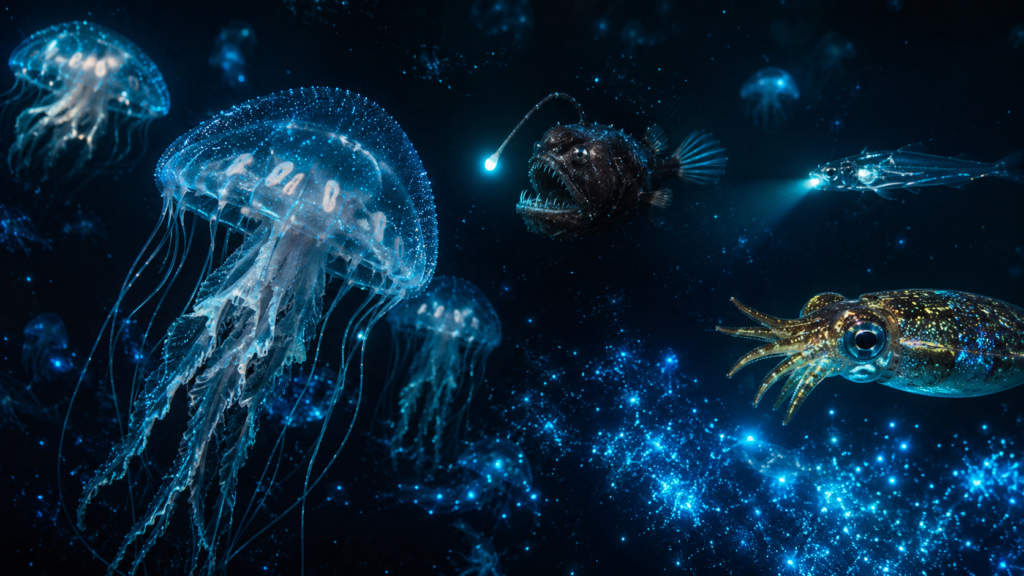
Imagine diving into the ocean at night and suddenly seeing tiny blue sparks surrounding you. Far below the surface, a strange fish waves a glowing lure in front of its mouth. Back on land, fireflies flash across a summer field.
These animals aren’t plugged into anything. They’re producing light through biology.
The phenomenon is called bioluminescence, and it is one of nature’s most spectacular adaptations. In many organisms, chemical reactions involving light-producing compounds generate the glow. Bioluminescence is particularly common in the ocean, where animals use light to find food, attract mates, communicate, confuse predators and even camouflage themselves.
1. Anglerfish
The deep-sea anglerfish may be the poster child for bioluminescence.
Females of some species carry a glowing lure extending from their heads. In the darkness of the deep ocean, curious prey may investigate that mysterious light—only to discover an anglerfish waiting behind it.
It’s essentially fishing with a built-in fishing rod.
2. Fireflies
One of the best-known examples of bioluminescence occurs right in our backyards.
Fireflies produce light in specialized organs in their abdomens. Their flashing displays are especially important for communication and courtship.
Different species can have characteristic flash patterns, helping potential mates find one another.
3. Hawaiian Bobtail Squid
This little squid has an especially interesting arrangement: it gets help from glowing bacteria.
Soon after hatching, bioluminescent bacteria colonize a specialized light organ in the squid. The partnership helps the squid use light as camouflage while the bacteria receive a protected place to live and nutrients.
4. Flashlight Fish
Flashlight fish look as though someone installed tiny lamps beneath their eyes.
Those glowing organs contain bioluminescent bacteria. Specialized structures allow the fish to effectively conceal and reveal the light.
The illumination can assist with activities such as communication and finding food in darkness.
5. Dragonfish
Some deep-sea dragonfish take underwater lighting to another level.
While blue-green bioluminescence is common because those wavelengths travel efficiently through seawater, certain dragonfish can produce red light. Many deep-sea animals aren’t equipped to detect red light well, potentially giving these predators something resembling a private flashlight.
6. Bioluminescent Jellyfish
Numerous jellyfish and jelly-like marine animals produce spectacular displays of light.
A sudden flash can serve as a defense mechanism. In the dark ocean, attracting attention isn’t always a bad thing: a burst of light may confuse an attacker or potentially attract an even larger animal that threatens the original predator.
Nature apparently invented the security alarm long before we did.
7. Glowing Plankton
Some of nature’s most breathtaking light shows come from organisms so small they’re easy to overlook.
Certain dinoflagellates—single-celled organisms found in marine plankton—produce flashes when the surrounding water is disturbed. Under the right conditions, waves, boats or swimmers can trigger brilliant blue sparkles across the water.
Why Is Ocean Bioluminescence Usually Blue?
Blue and blue-green wavelengths travel particularly well through seawater. That makes these colors useful in the marine environment, especially where sunlight is scarce.
And bioluminescence isn’t some rare biological accident. Scientists have found that the ability evolved independently many times during life’s history. Research has even traced animal bioluminescence back at least 540 million years in the lineage leading to certain corals.
The next time you see a firefly glowing in the backyard, remember: you’re watching one version of an ancient biological trick that illuminates some of the darkest places on Earth.